

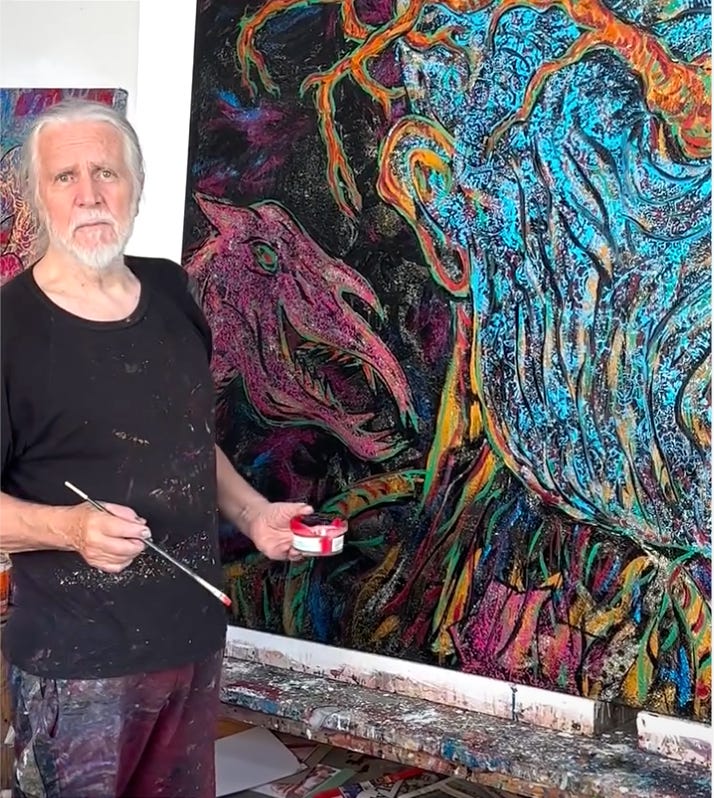
George Gittoes has made a new film called The Artist and the End. It had its world premiere at the Sydney Underground Film Festival this week, and the description accompanying it is not shy. “Unless our species changes course fast, we are about to witness the end,” it begins. Then comes the larger claim: a painting or poem may never have saved a life, but “the arts are all that can save humanity.” Gittoes has been arguing some version of this for much of his life: that art may not stop a war or save someone in the immediate sense, but it can stand against the forces that make people indifferent to what war does.
I am not sure I would go as far as he does. Artists have been claiming rather a lot for art for a very long time, and humanity has proved remarkably resistant to improvement. Even so, I have some sympathy with the impulse behind it. The words caught my attention because they sounded like an artist speaking in his own voice, without much concern for whether the claim was fashionable or easily defended.
Gittoes has been a strong anti-war advocate for decades, and unlike most artists who speak about war he has spent much of his working life close to it. Rwanda, Iraq, Afghanistan and Pakistan are not simply part of the biography. He worked there, observed, and made paintings, drawings and films from what he saw war doing to people. His anti-war position has been consistent for so long that it is difficult to separate from the artist himself. When Gittoes speaks about war or where humanity may be heading, people listen because he has spent years where those questions were matters of life and death.
We hear artists speak this way less often now. Gaza, rising antisemitism, war in Europe and the hardening of political argument have made discussion of conflict unusually fraught. Even countries that pride themselves on open argument seem less sure of what to do with disagreement.
It was not really the politics of the film, or even the claim that art might save humanity. What struck me was hearing an artist speak so freely about matters far beyond his own work, as though of course he had every right to do so. We used to hear artists speak like that far more often.
Once, artists were given rather more room to talk. There is an old black-and-white television interview with Henry Moore. John Freeman is mostly out of sight and Moore fills the screen, answering at length. The setting is plain, the pace slow, and Moore is simply allowed to talk. Nobody walks Moore through an exhibition or cuts away to close-ups of hands, clay and studio shelves. He is simply there, answering questions.
The assumption is that a major artist who has spent a life making sculpture and looking hard at the world might have something worth saying about it. Nobody first establishes whether he is qualified to discuss every subject that comes up, and nobody seems especially worried if the conversation wanders beyond sculpture. The point is simply to hear Henry Moore think.
Francis Bacon could be even more absorbing because he was less dependable. He might be perceptive, vicious, funny or ridiculous within a few minutes. David Hockney was always prepared to talk about almost anything that interested him, from perspective and photography to smoking, technology and the way people looked at pictures. Louise Bourgeois could change her mind, contradict herself and still sound entirely like herself. They were not always right, but they were unmistakably speaking for themselves.
It would be silly to pretend there was once a golden age in which artists wandered through public life dispensing uncommon wisdom. Famous artists were often listened to because they were famous. Some enjoyed the attention too much, while others mistook artistic success for expertise in almost everything else. A strong painter can hold a stupid political opinion and a good sculptor can be a bore. Watch enough old interviews and previous generations supply plenty of pomposity and nonsense, but at least the artists usually sounded like themselves.
Australian art had plenty of its own examples. Albert Tucker could talk about Australian culture with the impatience of somebody who had thought about it for years and had no particular desire to make himself agreeable. Noel Counihan’s politics were inseparable from his work and public life. Arthur Boyd’s concerns with religion, violence, guilt and human conduct were too deeply embedded to remain neatly inside the paintings. Brett Whiteley could talk extravagantly about art, drugs, beauty, Sydney and himself, sometimes all at once. Donald Friend wrote with a candour that remains both fascinating and deeply troubling.
None of these people offers a model to be copied. Some things said and done by earlier artists have aged badly and deservedly so. Friend is an obvious reminder that an interesting artistic voice does not guarantee an admirable life. The old idea that talent excused cruelty, selfishness or worse did enormous damage. We do not need any of that back to notice that artists have become more professionally managed and, often, more careful about what they say.
The contemporary artist works in a far more professionalised world. There are grants to apply for, residencies and commissions to win, gallery programs to fit into and institutions that require artists to explain themselves in advance. A painter is now routinely expected to say what the work is about, why it matters and how it fits the particular exhibition, prize or funding application at hand. Galleries need biographies and statements, curators need something they can quote, and museums need words for catalogues, websites and walls.
Much of this is perfectly reasonable. Artists should be able to answer emails, meet deadlines, send decent photographs and behave like adults. The old image of the painter as somebody too inspired to deal with ordinary obligations was always tiresome, particularly for the people around him who ended up doing the work. More interesting is what happens when that professionalism starts changing the way artists speak.
Read enough contemporary exhibition material and the same vocabulary keeps appearing. Artists investigate, explore and interrogate. Their practices engage with bodies, systems, histories, identities and materials. Things are complicated, unsettled or reconfigured. The writing is often perfectly competent and sometimes very good, but it can be hard to imagine the person who made the work speaking that way over lunch.
I have known artists whose conversation is sharp, funny and opinionated, only to read their official statement and wonder where they went. Somebody who will tell you immediately that a painting is dreadful suddenly appears in print as a model of curatorial tact. An artist with very definite ideas about what matters in painting becomes careful and general. Somewhere along the way, artists learned to stop sounding like themselves.
This is not entirely the artist’s doing. The language has been learned because it works. It gets applications through committees, gives curators something they can use and helps work move through institutions. Young artists meet it at art school and soon understand what it can do for them. It is hardly surprising that people become fluent in the language on which opportunities depend.
Somewhere along the way, artists learned to stop sounding like themselves.
We also know more about artists’ biographies than ever before. We are told about family histories, cultural backgrounds, communities, formative experiences and the social circumstances surrounding the work. Sometimes this genuinely helps. Sometimes it is essential. Yet it is quite possible to know all of that and still have very little sense of the artist himself. The biography becomes fuller while the person behind it remains oddly indistinct.
Perhaps we have also become less comfortable with the idea that artists should speak beyond their expertise. There is some sense in that. A painter is not automatically qualified to explain a war or tell us how to vote, and a sculptor does not become a moral authority because a museum acquires the work. The twentieth century supplied more than enough evidence that people of exquisite culture can still be politically foolish, morally compromised or simply wrong.
I do not want successful artists treated as authorities on everything, nor do I think every exhibition needs to come with a position on the latest political crisis. We already have more public opinion than we can sensibly absorb, and the pressure on everyone to declare a position has produced plenty of certainty without much thought.
Some artists are naturally private, and there is nothing wrong with that. What seems less common is the artist who does have something to say and says it in a voice recognisably his own.
Political art itself is hardly scarce. Contemporary galleries and museums are full of work about war, colonial history, race, migration, inequality, identity and the environment. Some of it is excellent and some of it is thin. A political subject tells us very little by itself about how independently an artist is thinking.
A political position can be entirely conventional within the world in which it is expressed. An artist can make radical-sounding work while saying almost nothing that would surprise the people most likely to see it. The language may be oppositional while the audience is already in agreement. There is nothing necessarily wrong with that, but it is a long way from a position arrived at over years and lived through the work.
Gittoes has been anti-war through changes in fashion, politics and the art world around him. He has not needed to reinvent that position to make it current. The work keeps going back to war, suffering and what people do to one another because he has never been finished with those subjects, and The Artist and the End comes naturally out of that history. Whether it turns out to be one of his best films is another matter. The claim itself is large enough: humanity is in danger and art still has some part to play.
I prefer that to the smaller language we have become accustomed to. I would rather hear an artist say something too large than spend another afternoon reading that a work “opens a dialogue” about a subject on which almost everybody in the room already agrees. Gittoes gives us something worth arguing with: whether art has ever saved anyone, whether painting or film can do anything against war beyond recording it.
I would rather hear an artist say something too large than spend another afternoon reading that a work ‘opens a dialogue’ about a subject on which almost everybody in the room already agrees.
My own answer is considerably less optimistic than his. Paintings have not prevented wars and poetry has not abolished cruelty. People capable of loving Bach, Goya or Rembrandt have managed to behave appallingly. Culture and barbarity have always lived quite comfortably beside one another, which makes any claim for art as salvation difficult to sustain.
Yet there is nothing naïve about Gittoes’s position. He has seen too much for that. His faith in art seems to rest on the idea that witnessing matters, and that turning what he has seen into paintings and films can stop people looking away even if it cannot stop the event itself. He has acted on that belief repeatedly, often in circumstances where making art must have seemed a strange response to what was happening around him. I can doubt the size of the claim and still respect the life behind it.
The atmosphere around public speech has changed as well. Artists now speak in a culture quick to sort people into camps. Gaza, Ukraine and arguments over antisemitism have made that brutally clear. Disagreement can harden very quickly into suspicion about motive, character or allegiance.
There are good reasons to speak carefully about war, race or religion. Carelessness can do real harm, and ignorance is not improved by being expressed confidently. But there is also a cost when difficult subjects become so guarded that only familiar formulations survive. Everybody may still be talking, but fewer people are saying very much.
Artists once fitted rather naturally into that kind of public life because they were not expected to be entirely respectable. They could be politically eccentric, religious, atheistic, conservative, communist, mystical, materialist or simply impossible to classify. The work was judged, the person argued with, and one did not automatically cancel out the other.
That is harder now because reputations are more carefully built and protected. Successful artists have galleries, collectors, museum relationships and public profiles that may take decades to establish. A gallery representing an artist is protecting an investment as well as a relationship. Museums have donors, audiences and reputations of their own. Nobody needs to issue instructions for caution to become part of the atmosphere.
The Australian art world is small enough for the same people to keep reappearing. A curator may later judge a prize. A critic may sit on a panel. A collector may become a museum donor. Artists know this because they live inside it, and it would be foolish to pretend that knowledge has no effect. That does not mean Australian artists are frightened into silence. Many are simply busy making work and earning a living, and some have no interest in becoming public figures. I wonder whether we have also stopped expecting them to be.
Australian artists have certainly been capable of seeing their society oddly and sharply. Tucker’s Australia was not the Australia of official speeches. Counihan’s politics gave him another view of the city. Whiteley’s Sydney was exaggerated, narcissistic and unmistakably his. Arthur Boyd could take religion, myth, landscape and Australian history and make them part of the same moral world. One did not have to agree with them to understand why people wanted to hear them.
Criticism once gave artists another reason to develop voices of their own. The relationship between artist and critic could be abrasive because both sides assumed disagreement was legitimate. Robert Hughes could be savage. John McDonald can still be very direct. Christopher Allen is prepared to say when the work, or the claims made for it, are unconvincing. Artists answered critics, sometimes furiously, and nobody imagined that criticism was simply another arm of promotion. If somebody was going to make claims about your work in public, you might want to answer.
Much writing around exhibitions now begins with the artist’s stated concerns and the curator’s account of them. The critic may assess how successfully the work fulfils those intentions, but the basic frame is often accepted before the writing begins. The possibility that an artist misunderstands his own work, or that a curator has made too much of one strand and missed another, appears less often than it should. Artists can be wrong about their own paintings and critics can be wrong too. Having both is more interesting when neither is expected simply to confirm the other.
Contemporary culture is also much less willing to excuse bad behaviour because somebody happens to be talented, and rightly so. But bad behaviour and an objectionable opinion are not the same thing. If we lose that distinction, public speech inevitably becomes safer and more managed.
Gittoes is not a silenced artist. His views are well established and widely respected. What makes him useful here is that he seems largely to have escaped this caution.
That is why The Artist and the End does not feel ridiculous even when its language comes close to grandiosity. Another artist announcing that art can save humanity might send me straight for the exit. Gittoes has made the proposition harder to dismiss because it comes after a lifetime spent asking what art can do in the presence of war.
He is also still experimenting. The use of AI-assisted animation in the new film is an interesting choice for an artist of his generation, particularly when so much anxiety about artificial intelligence is coming from artists themselves. He could easily have denounced it from the sidelines. Instead he has used it. Whether that makes for a good film is another matter, but I like the fact that he is still curious enough to try.
At a certain point in a long career, repetition becomes tempting. Audiences know what they want, galleries know what they can sell and institutions know which version of an artist fits the history already written. An established artist can spend a surprisingly long time confirming himself. Gittoes has never seemed entirely comfortable doing that.
His example also makes clear the difference between making art about public subjects and actually having a public voice. The two can overlap, but they are not the same. An artist can make work about enormous political questions and remain personally almost inaudible. Another can paint still lifes and have a remarkably expansive mind. The subject of the painting tells us very little about the size of the artist’s world.
I would like to hear more of that world from Australian artists. Not more slogans or compulsory political declarations, and certainly not every painter turned into a commentator. I would like to hear artists speak in ways that make them recognisable without having to read the name underneath. I want to know what they think about beauty without the word becoming embarrassing, about money without pretending money has nothing to do with art, about religion if they believe in it, about class, ambition, failure and ageing. I would like to hear them say that a museum has become ridiculous, that a critic is wrong, or that an artist they admire has made a bad painting.
Some of those opinions would be foolish and some would irritate me. That is unavoidable if the voice is genuinely somebody’s own. Artists are probably more visible now than at any time before, yet much of what reaches us is about the work, the career and the approved account of both.
Gittoes came back from the places he worked with opinions rather than simply subject matter. His belief in art may ask more of art than I think it can deliver, but at least the belief is his.
Living in Australia now, I find that sort of confidence harder to dismiss than I might once have. Public life already has enough prepared positions and language designed not to cause trouble. The art world does not need another layer of it. If artists begin sounding exactly like the institutions, galleries and professional culture around them, we lose one of the reasons their voices were worth hearing in the first place.
George Gittoes has spent decades speaking plainly about war, art and the world he has witnessed. There is an authenticity in that which is difficult to fake. I do not believe the arts are all that can save humanity, and I am not even sure they can save very much. But I would rather live in an Australia where an artist is prepared to make that claim and argue for it than in one where artists are everywhere and we can barely hear what any of them actually think.
Andrew McIlroy is an Australian artist who writes about art, artists and the culture around them.